Kavya Desai
Physicist / Quantum Researcher
Works at the scale where particles don't follow the rules you grew up with — on purpose.
Day in the Life
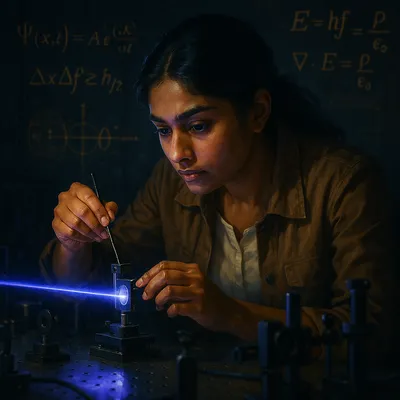
The lab is dark except for the dull red glow of laser-safety lighting and the blue flicker of oscilloscope traces. Kavya Desai is hunched over an optical table, tuning a mirror mount with a tool no bigger than a toothpick. Half a millimeter matters here — she’s aligning a laser path that will cool a single trapped ion down to a fraction of a degree above absolute zero.
Why that cold? Because at everyday temperatures, atoms jiggle too much to hold one of the strange quantum states Kavya’s team needs: a superposition, where the ion is — genuinely — in two energy states at once, until it’s measured. That one ion, still and cold and isolated, is a qubit: a basic unit of a quantum computer.
By mid-morning the run is live. Kavya watches thousands of repeated experiments: prepare the superposition, wait a sliver of a second, measure it, repeat. Sometimes it lands one way, sometimes the other — in proportions that match a calculation she did the night before, to four decimal places.
“That’s the part that gets me every time,” she tells a visiting student. “It’s not random randomness. It’s randomness that obeys an equation.”
In the afternoon she’s back at her desk — no lasers, just a notebook full of equations — working out how long their qubit can hold its state before outside noise scrambles it (its “coherence time”), and whether a redesigned trap could double it. If it works, today’s half-millimeter mirror adjustment might end up part of a quantum sensor sensitive enough to catch a single gravitational-wave ripple, or a future quantum computer that can simulate molecules no ordinary computer can touch.
The Science
Superposition — not “we don’t know yet,” but “genuinely both”
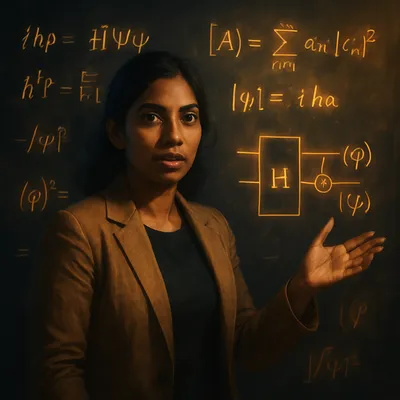
In everyday life, if a coin is hidden under a cup, it’s definitely heads or tails — you just don’t know which. A quantum particle in superposition is different: until it’s measured, it doesn’t have a single definite value for certain properties. Both possibilities are simultaneously “real,” described by a mathematical object called a wavefunction. Measurement doesn’t reveal a pre-existing answer — it forces the system to “choose,” with probabilities set by the wavefunction.
Probability amplitudes
The wavefunction assigns each possible outcome a probability amplitude — a number (technically complex-valued) whose squared magnitude gives the probability of that outcome. Kavya’s “four decimal places” prediction comes from squaring these amplitudes. This is why quantum mechanics is sometimes called a theory of probabilities with interference — amplitudes can add together or cancel out in ways that ordinary probabilities never do, which is part of what gives quantum computers their power.
Wave-particle duality
The famous double-slit experiment shows that particles like electrons and photons produce an interference pattern — a hallmark of waves — even when fired one at a time. Yet each one lands as a single point, like a particle. Wave-particle duality is the idea that quantum objects aren’t fully described by either everyday picture; the wavefunction (wave behavior) determines the probabilities of where a particle (particle behavior) will be detected.
Qubits and quantum computing
A classical computer bit is 0 or 1. A qubit can be in a superposition of 0 and 1 simultaneously. A handful of qubits in superposition can represent an enormous number of combinations at once — which is why quantum computers are especially promising for problems like simulating molecules (chemistry, drug discovery) and certain optimization and cryptography problems, though they’re not simply “faster classical computers” for everything.
Want to see real curves and equations in action rather than just in words? Problem A graphs a spacecraft’s motion using calculus — the same mathematical language physicists use every day. Try Problem A →