
Noa Lindqvist
Marine Biologist
Spends her workday underwater, chasing the chemistry that's quietly reshaping the ocean.
Day in the Life
The dive briefing happens on deck while the sun’s still low: today’s transect line runs along the same stretch of reef Noa Lindqvist’s team has monitored for six years. Tanks checked, slates clipped on, over the side.
Twelve meters down, the reef is loud with life — parrotfish grinding algae off rock, damselfish scattering and reforming, clicks and pops from things she can hear but never quite see. Noa swims the transect slowly, logging every few meters: which coral colonies look healthy, which are bleached (stark white, tissue gone translucent), which are just dead and covered in algae. Water samples go into sealed bottles at fixed depths, headed back to the lab for pH and temperature.
Bleaching isn’t corals “dying” outright. It’s corals evicting their roommates.
Each coral polyp hosts millions of microscopic algae living in its tissue — the algae photosynthesize and hand most of the food over to the coral. When water runs too warm or too acidic, the coral’s stress response is to kick the algae out, losing its color and its main food source in one move. A bleached coral isn’t dead yet. It’s starving.
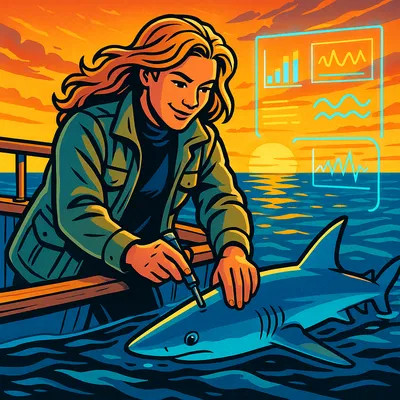
Back on the boat, Noa runs the samples through a portable analyzer. The pH numbers from six years on this reef show a slow, real downward drift — the ocean’s version of a low-grade fever. In the afternoon she tags a juvenile reef shark with an acoustic transmitter, part of a separate project tracking how young sharks use this reef as a nursery. Coral health, water chemistry, shark movements — every data point gets logged, dated, added to a set now long enough to show trends, not just snapshots. One bad year could be weather. Six years in the same direction is a signal.
The Science
Ocean acidification — carbon dioxide dissolving into seawater
The ocean absorbs a large share of the carbon dioxide (CO₂) humans add to the atmosphere. When CO₂ dissolves in seawater, it reacts with water to form carbonic acid (H₂CO₃), which makes the ocean very slightly more acidic — measured as a small drop in pH (the scale that measures how acidic or basic a solution is; lower pH = more acidic). This matters enormously for organisms like corals and shellfish, which build their skeletons and shells out of calcium carbonate — a more acidic ocean makes that building process harder, similar to how acid slowly dissolves chalk.
Coral bleaching and symbiosis
Corals are animals (tiny polyps related to anemones) that live in a symbiotic relationship with photosynthetic algae called zooxanthellae living inside their cells. The algae get a protected home and a steady supply of the coral’s waste products (which they use as nutrients); the coral gets up to 90% of its energy from sugars the algae produce via photosynthesis. Bleaching is the breakdown of this partnership under stress (most often heat stress) — the coral expels the algae, loses its color (the algae’s pigments were what gave the coral its color), and loses its main energy source.
Bioluminescence
Many deep-sea and reef organisms — including some jellyfish, plankton, and fish — produce their own light through bioluminescence: a chemical reaction between a light-emitting molecule (a luciferin) and an enzyme (a luciferase) that releases energy as visible light rather than heat, similar in principle to a glow stick. Organisms use it to attract prey, startle predators, or communicate — useful tools in an environment where sunlight disappears within the first couple hundred meters of depth.
Trophic levels and food webs
A reef’s food web is organized into trophic levels: producers (algae and zooxanthellae, which make food via photosynthesis), primary consumers (herbivores like parrotfish, which eat the producers), and successively higher-level predators (like the juvenile reef sharks Noa tags). Energy decreases at each step up the chain — typically only about 10% of the energy at one trophic level transfers to the next, which is part of why top predators are naturally far less numerous than the producers and herbivores below them.

Reef water pH, six-year trend
A small number — a few hundredths of a pH unit — but a real, steady drift. That’s ocean acidification showing up in Noa’s own data.