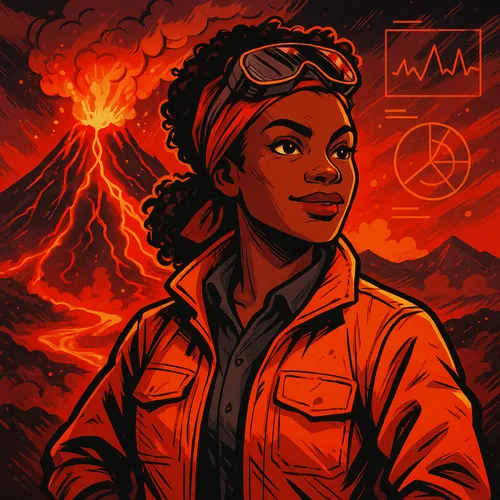
Talia Okafor
Geologist / Volcanologist
Reads the mountain like a pressure gauge — and gets everyone off it before it blows.
Day in the Life
The hike up starts before dawn, while the rock is still cool enough to walk on without boots melting at the soles. Talia Okafor and her field team are climbing the flank of an active volcano that’s been “restless” for three weeks — small earthquakes, a new sulfur smell, ground that’s measurably rising. Today’s job: service the seismometers and gas sensors ringing the crater, and grab a fresh sample of the lava now creeping out of a vent that opened two days ago.
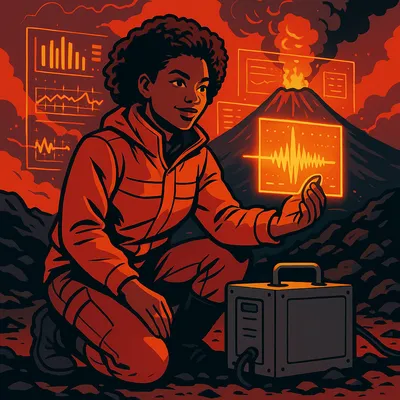
At the first station she pulls data off a seismometer the size of a coffee can, buried in the dirt. The squiggly lines look like static to most people. To Talia, they’re a story: sharp jolts mean rock cracking as magma forces its way up; slower rumbles mean fluid — magma or gas — moving through cracks that already exist.
The pattern’s been sliding from the first kind to the second. That’s exactly the shift that comes before an eruption.
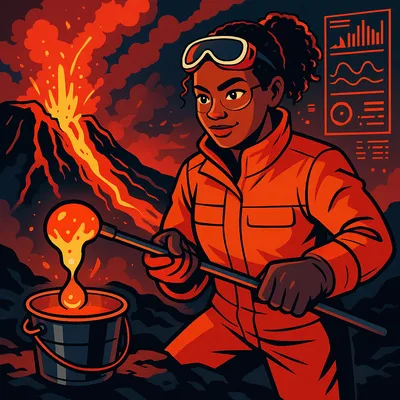
At the vent, she moves fast — heat-resistant gloves, a long sample pole, a steel bucket to scoop glowing lava and quench it in water. Back at the truck, she’ll check how it crystallizes: thick, sticky, high-silica lava traps gas and can build toward an explosive blast; thin, runny, low-silica lava just flows. Today’s sample, plus the rising sulfur dioxide reading, feeds straight into the model her team uses to brief the regional emergency office. If the numbers cross a threshold, evacuation orders go out before anything visible happens. That’s the whole point.
By evening, back at the observatory, Talia plots today’s readings against three weeks of history. The trend is clear: this volcano is charging up. She can’t say exactly when it’ll erupt — nobody can, precisely — but she can say how it’s likely to erupt, and that’s often the more useful answer.
The Science
Plate tectonics and why volcanoes are where they are
Earth’s crust is broken into large, slowly moving plates, floating on a hotter, softer layer of rock beneath (the mantle). Most volcanoes form along plate boundaries — where plates pull apart (letting hot mantle rock rise and melt), collide (forcing one plate down into the mantle, where it melts), or where a stationary “hot spot” of rising magma punches through a plate as it drifts overhead. Talia’s volcano sits above a subduction zone, where an oceanic plate is sliding beneath a continental one.
Magma viscosity — the difference between a slow flow and a sudden blast
Viscosity describes how strongly a fluid resists flowing — honey vs. water. Magma’s viscosity depends heavily on its silica (SiO₂) content:
- Low-silica (basaltic) magma is runny. Gas bubbles escape easily, so eruptions tend to be effusive — lava flows, fountains, relatively gentle.
- High-silica (rhyolitic) magma is thick and sticky. Gas bubbles get trapped, pressure builds, and eruptions tend to be explosive — the trapped gas expands violently when pressure finally releases, shattering the magma into ash.
This is why Talia’s quench-and-crystallize test matters: it’s a direct read on what kind of eruption is brewing.
Seismic waves — P-waves and S-waves
Earthquakes (including the small ones around a stirring volcano) send out two main kinds of seismic waves:
- P-waves (primary) are compressional — they squeeze and stretch rock in the direction they travel, like a sound wave. They’re faster and arrive first.
- S-waves (secondary) are shear waves — they move rock side-to-side, perpendicular to their direction of travel. They’re slower, and notably, S-waves can’t travel through liquid — which is part of how geologists figured out Earth’s outer core is molten.
The time delay between a P-wave and S-wave arriving at a sensor tells you how far away the source was — the same principle (different wave speeds covering the same distance in different times) shows up anywhere you’re comparing rates over a fixed distance, including the travel-time problem in Problem A.
Volcanic gas monitoring
Magma carries dissolved gases — mostly water vapor, carbon dioxide, and sulfur dioxide (SO₂). As magma rises and pressure drops, these gases come out of solution (the same reason a soda fizzes when you open it) and reach the surface before the magma does. Rising SO₂ readings are one of the most reliable early-warning signs that magma is moving upward — which is why Talia’s gas sensors get checked on every visit.
Sulfur dioxide readings, three weeks of unrest
Rising SO₂ means gas — and the magma carrying it — is working its way up. This is the exact climb that sends Talia’s team to brief the emergency office.